


Virtual assistants provide critical leverage for business owners seeking rapid operational scale. Business owners struggle with delegation and communication, expecting a quick fix rather than managing a remote team member properly. The strategic delegation of repetitive tasks frees executive bandwidth for high-value revenue generation. Founders audit personal time usage to identify exactly which administrative burdens choke organizational growth. A properly structured remote workforce transitions a chaotic startup into a predictable corporate machine.
During my 2 years working as a Customer Manager at the Grameenphone (Telenor ASA) Service Desk under the Customer management division, identifying the customer pain point and solving it properly directly improved the Customer Experience index. The US Bureau of Labor Statistics reported a median wage of 34.75 dollars per hour in May 2024. Offshore rates provide substantial financial leverage compared to domestic payroll liabilities. Entrepreneurs utilize global talent pools to maintain continuous customer support across multiple international time zones. The procurement process requires meticulous candidate screening and rigid standard operating procedures.
If you are in the advisory space and looking to hire a virtual assistant, the exact workflow requirements may differ significantly.
If your bottleneck is strategy rather than bandwidth, it may be time to hire a fractional executive assistant instead.
What is a Virtual Assistant?
A virtual assistant is a remote contractor providing administrative, technical, or creative support to a business from a home office. These specialized professionals handle data entry services, calendar scheduling, and proactive client communication for busy entrepreneurs.
Remote workers utilize time tracking software and centralized project management tools. These tools measure virtual assistant productivity and deliver measurable operational output. The integration of artificial intelligence tools accelerates complex digital marketing campaigns. Establishing a clear scope of work prevents scope creep and focuses the contractor on high-leverage activities. Understanding exactly what a virtual assistant is covers this concept in complete detail.
The 5 core categories of remote business support are listed below.
- General Administration: Inbox triage and calendar control return 15 hours of executive time each week.
- Financial Operations: QuickBooks reconciliation closes the monthly ledger inside 3 business days.
- Customer Support: Zendesk ticket resolution drastically decreases average wait times for e-commerce brands.
- Digital Marketing: Hootsuite schedule management maintains consistent online brand visibility across social platforms.
- Technical Maintenance: WordPress plugin updates prevent catastrophic website downtime during peak sales seasons.
Why is Hiring a Virtual Assistant So Hard?
Hiring a virtual assistant fails when founders delegate complex workflows without providing standard operating procedures or clear performance metrics. Remote work completely removes the ease of casually stopping by a physical desk to clarify ambiguous project instructions.
Without a rigid culture of daily communication, remote contractors feel disconnected. Vital project deadlines drift completely off-course. A hiring mistake accelerates contractor turnover and multiplies wasted training hours. Founders select candidates based solely on the absolute lowest hourly rate. This flawed strategy generates severe skill mismatches that inflate onboarding costs. The friction stems directly from the entrepreneur refusing to transition into an effective managerial role.
The 3 primary friction points in remote workforce delegation are listed below.
- Process Ambiguity: Expectant business owners force new contractors to reverse-engineer undocumented company workflows blindly.
- Micromanagement Tendencies: Anxious executives refuse automated time tracking software and revert to manual administrative tasks.
- Tool Deficiencies: Fragmented email threads scatter institutional knowledge because teams lack centralized project management platforms.
What Tasks Should You Delegate to a VA?
Business owners should delegate repeatable, rules-based processes that consume executive bandwidth but require absolutely zero strategic decision-making. Identifying the correct administrative tasks requires auditing personal time usage meticulously for two consecutive work weeks.
Entrepreneurs isolate the 80 percent of administrative grunt work yielding only 20 percent of total business revenue. A rigorous delegation framework categorizes responsibilities by their direct impact on overall corporate profitability. You can directly hire digital marketing virtual assistants to function as specialized operators for marketing tasks. Uploading finalized articles into a Content Management System is a perfect delegation candidate.
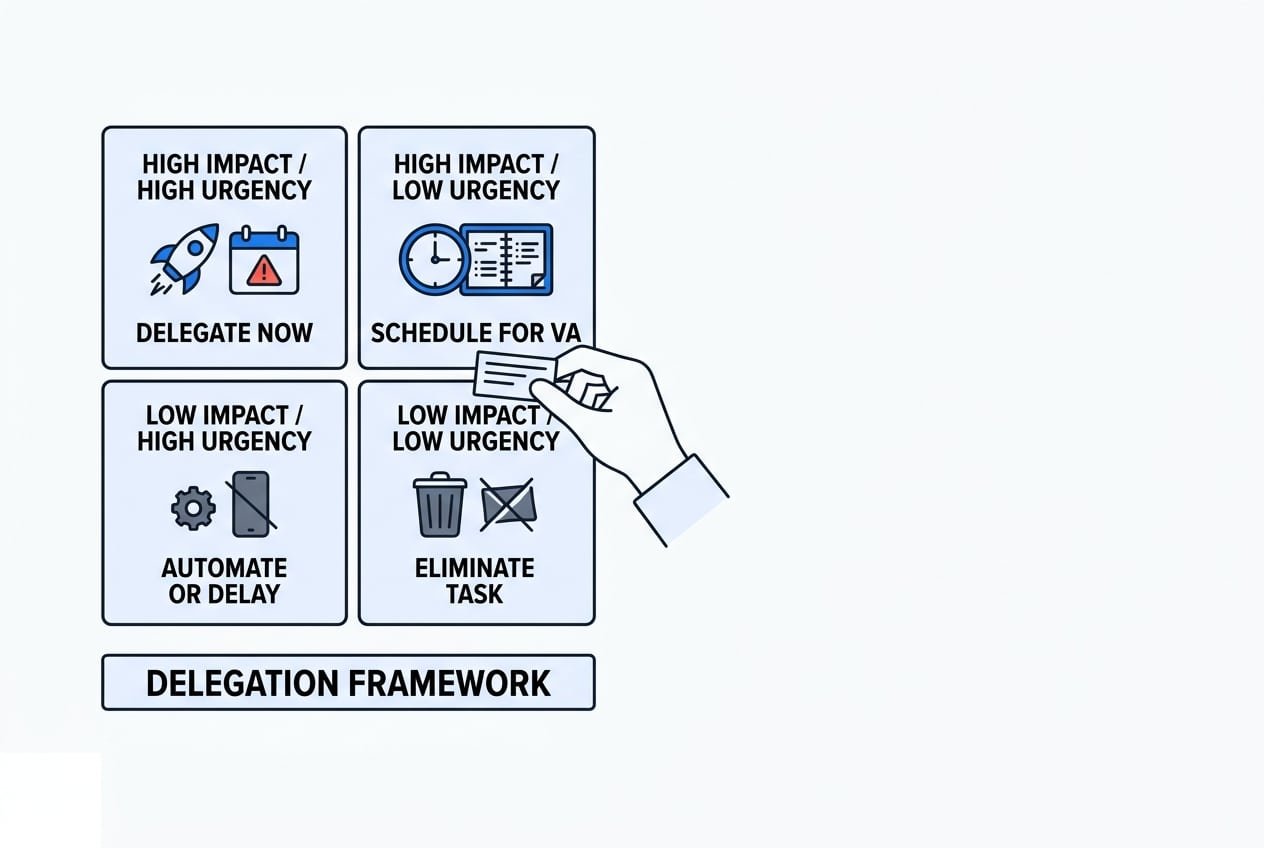
The 4 optimal task categories for immediate offshore delegation are listed below.
- Inbox Triaging: Vendor solicitation filters flag only the most urgent client inquiries for executive review.
- Data Migration: Raw lead transfers from web forms into Salesforce maintain pristine customer relationship management hygiene.
- Travel Coordination: International flight bookings and itinerary documents eliminate hours of frustrating logistical friction.
- Content Formatting: Blog article uploads into WordPress ensure immediate publishing readiness without senior oversight.
Freelance Platforms vs. Managed VA Agencies
Freelance platforms provide direct access to global talent pools, while managed virtual assistant agencies supply pre-vetted contractors and handle all human resources compliance. Startups accept the recruitment burden, while established enterprises pay premiums for immediate reliability.
Platforms like Upwork and Fiverr connect desperate clients with independent operators. These platforms charge lower hourly rates but require extensive manual screening efforts. Agencies like Belay Solutions and Time Etc charge premium monthly retainers. A managed agency screens virtual assistants vigorously to guarantee continuous service coverage. These agencies completely eliminate painful recruitment timelines. You can explore various service providers to compare specific corporate vendors.
The 4 structural differences across remote talent sourcing models are listed below.
| Dimension | Freelance Platforms | Managed VA Agencies |
|---|---|---|
| Recruitment Speed | 2 to 4 weeks | 48 to 72 hours |
| Vetting Responsibility | Client executes | Agency guarantees |
| Replacement Policy | Client re-hires | Agency swaps immediately |
| Cost Structure | Hourly variable | Monthly fixed retainer |
What Are the Most Common Hiring Mistakes?
The most expensive hiring mistake occurs when businesses select the cheapest offshore candidate without testing their English proficiency or software competency. Selecting an independent contractor based purely on a low hourly rate exponentially increases employee turnover.
Failing to execute a paid test project forces naive employers to discover severe technical incompetence. They discover this incompetence only after signing the binding independent contractor agreement. The absence of a formal 30-day probationary period prevents managers from terminating underperforming individuals quickly. The long-term damage of a toxic hire always outweighs the short-term savings of a rushed recruitment cycle.

The 3 critical errors accelerating remote contractor turnover are listed below.
- Role Stuffing: Complex graphic design combinations with advanced corporate bookkeeping repel highly specialized professionals.
- Cultural Assumptions: International time zone ignorance generates immediate operational friction during critical project handoffs.
- Onboarding Neglect: Raw system access without accompanying Loom video tutorials leaves new hires completely blind.
How Much Does it Cost to Hire a Virtual Assistant?
Hiring an offshore virtual assistant costs between 4 and 20 dollars per hour, while US-based professionals command 25 to 60 dollars hourly. The total financial commitment depends entirely on the contractor’s geographic location and proven technical specialization.
A full-time remote worker based in the Philippines costs approximately 800 to 2600 dollars monthly through borderlessrecruit.com. Specialized operators possessing advanced digital marketing certifications always demand top-tier compensation regardless of their physical location. Establishing a realistic budget prevents companies from chronically underpaying. Chronic underpayment ultimately loses the best talent to aggressive corporate competitors. Offshore rates provide substantial financial leverage for bootstrapped startups.
The 3 baseline hourly compensation rates across major global markets are listed below.
| Region | General Administrative | Specialized Technical | Source |
|---|---|---|---|
| Offshore (Philippines, India) | $4 – $10 | $15 – $25 | myvirtualmate.com |
| Latin America (Nearshore) | $7 – $15 | $20 – $35 | virtustant.com |
| United States (Domestic) | $25 – $40 | $50 – $75+ | wingassistant.com |
The Step-by-Step Process to Hire a Virtual Assistant
Successfully hiring a remote contractor requires defining the job description, screening applicants through a paid test project, and executing a structured onboarding phase. The corporate recruitment pipeline must aggressively filter out candidates lacking specific software competencies.
Evaluating eager applicants strictly on their ability to follow precise instructions eliminates unreliable operators. This elimination occurs long before formal video interviews happen. A test task reveals practical execution capability far better than a highly polished resume. The vetting mechanism challenges the candidate’s strategic problem-solving capabilities. A meticulous selection process virtually guarantees a high retention rate.
The 5 essential stages of remote workforce procurement are listed below.
- Needs Analysis: Daily activity documentation identifies the exact administrative bottlenecks currently choking organizational growth.
- SOP Creation: Raw screen-capture videos build the foundational training library required for rapid remote knowledge transfer.
- Role Specification: Highly detailed job descriptions filter out completely unqualified candidates immediately upon posting.
- Skills Verification: Two-hour paid trial assignments prove the applicant truly possesses necessary technical proficiency.
- Cultural Alignment: Zoom video interviews confirm internet connection stability and spoken English fluency.
How Do Business Owners Manage Virtual Assistants?
Entrepreneurs manage virtual assistants by establishing daily communication rhythms, enforcing time tracking protocols, and measuring operational output against predefined key performance indicators. Effective remote leadership permanently transitions the fragile relationship into a highly collaborative corporate partnership. Managers invest heavy time into the initial 30-day integration phase. This investment produces exponentially higher long-term productivity and contractor loyalty. Continuous feedback loops eliminate confusing ambiguity. The contractor executes their daily duties with absolute confidence.
How do you write a clear job description?
A clear job description outlines the specific daily deliverables, required software proficiencies, and exact working hours expected from the contractor, especially when hiring for administrative support. Ambiguous online postings attract entirely unqualified applicants. Listing specific proprietary tools acts as an immediate technical filter.
What test tasks reveal candidate quality?
Paid test tasks requiring data entry processing or basic internet research expose a candidate’s actual competency. Evaluating the raw speed and total accuracy prevents vulnerable businesses from hiring theoretical experts. The assignment mirrors the exact complexity of daily tasks.
How do you build standard operating procedures?
Founders build standard operating procedures by recording their screens while executing a specific task. They narrate the exact decision-making process out loud. Using detailed content writing to transform these raw Loom videos into highly structured written Google Docs creates a permanent training asset.
Which communication tools work best for remote VAs?
Slack facilitates rapid daily messaging, while sophisticated project management platforms centralize task assignments. Reputable virtual assistant services mandate these specific communication protocols across all client accounts. Combining asynchronous chat protocols with structured digital ticketing prevents critical project details from getting buried during ecommerce store support.
How do you set KPIs for a VA?
Managers set key performance indicators by defining measurable weekly outputs. Quantifiable corporate targets completely remove subjective performance evaluations. KPIs demonstrate concrete return on investment clearly. Goal alignment ensures the contractor focuses purely on activities driving measurable business growth, such as increasing organic traffic through SEO services.
How long does onboarding take?
Comprehensive virtual assistant onboarding requires two to four weeks of intensive feedback. The onboarding phase requires daily communication before the contractor operates fully independently, whether they are handling inbox triage or social media management. Rushing this critical integration phase virtually guarantees recurring operational errors.
3 comments